
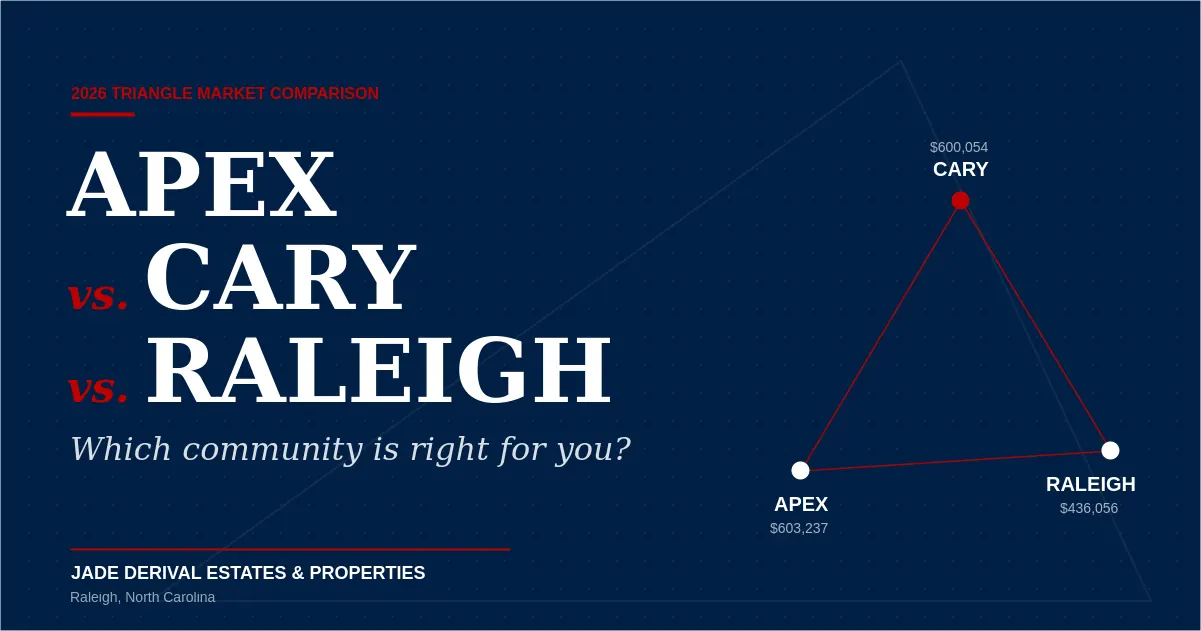
If you are moving to the Triangle or you already live here and you are thinking about moving the question is not just where can you afford to live it is which town is really the fit for the way you want to live.
The towns of Apex and Cary and Raleigh are all close to each other you can drive to any of these towns in twenty minutes. Each town has its own way of life its own prices and its own personality.
The Research Triangle Park and the good schools in Wake County and all the people moving to the area are changing the markets in Apex and Cary and Raleigh in the year 2026. So it really matters what is different about each of these towns for people who are buying a house selling a house or investing in a house, in Apex and Cary and Raleigh.
This comparison is not about the average price of a house on a website. We will look at what’s happening in the market right now what it is like to live in each town every day how long it takes to get to work what the schools are like what family life is like what other costs you will have to pay besides your mortgage and which town is best for which kind of buyer. When we are done you should know where to look for a house whether you are buying a house for the first time moving to a new job, at RTP or thinking about investing in one of these towns.
Home Prices & Market Snapshot: Apex vs. Cary vs. Raleigh (2026)
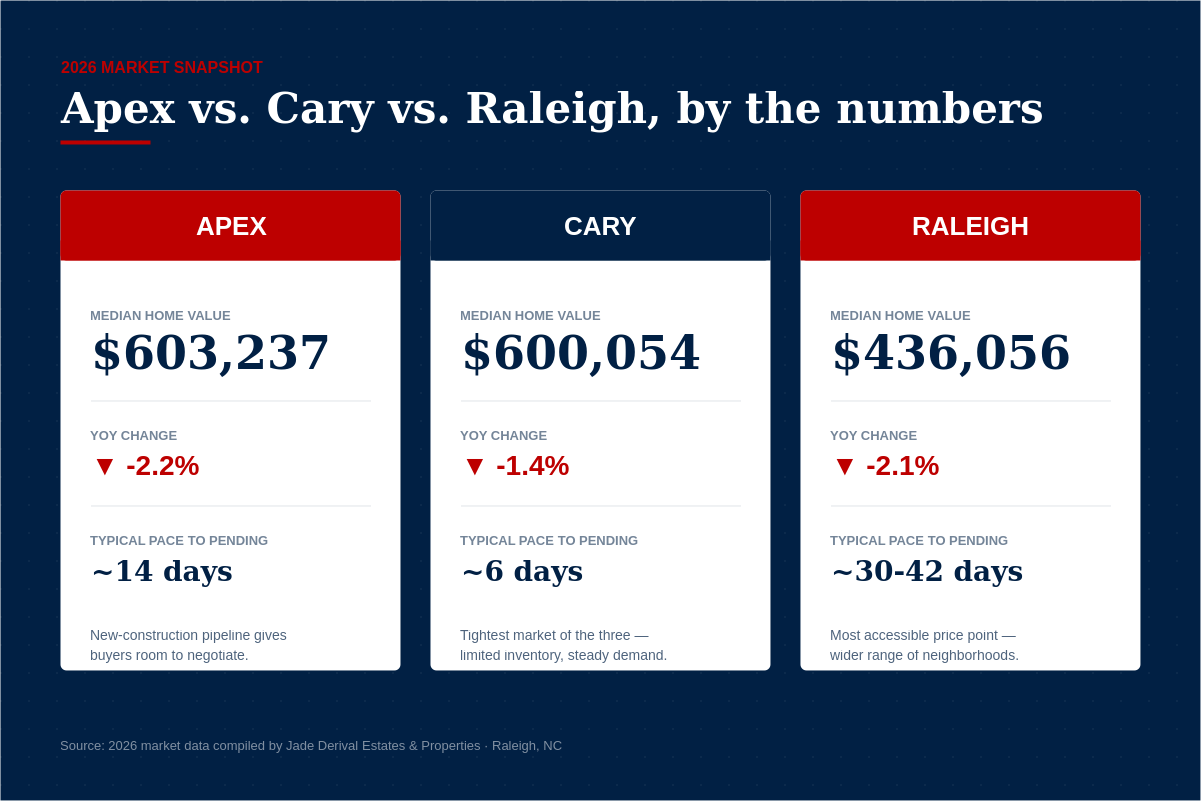
Here’s how the three markets compare on the numbers that matter most right now:
| City | Median Home Value | YoY Change | Typical Pace to Pending |
| Apex | $603,237 | -2.2% | ~14 days |
| Cary | $600,054 | -1.4% | ~6 days |
| Raleigh | $436,056 | -2.1% | ~30-42 days |
A few things stand out. Cary is the tightest market of the three, with homes going to pending in about six days, a sign of strong, steady demand and limited inventory. Apex isn’t far behind, and its new construction pipeline gives buyers more room to negotiate than Cary’s more built-out neighborhoods. Raleigh, meanwhile, offers the most accessible price point of the three, with a wider range of neighborhoods, price bands, and a noticeably slower, more balanced pace, which can work in a buyer’s favor.
Lifestyle & Community Character
Apex is a cool place that still has a small-town feel:
People can walk around the downtown area. It feels like a little community. The main street in Apex is very popular. Has a lot of great restaurants and shops that are owned by people who live there? There are always things to do like the Apex Peak Fest.
New homes are being built on the side of town and people are moving there because they want a nice new house, good schools and a shorter drive to work at RTP. They also like that Apex has a sense of community. A time ago in 1990 Apex only had around 5,000 people living there. Now Apex has around 75,000 people. It is one of the biggest cities in the Triangle even bigger than Chapel Hill. This means that the city has to plan for things, like schools and roads because so many people are moving to Apex.
For people who want to buy a house the growth in Apex is a thing and a bad thing. On the one hand new homes are being built so buyers have options and can often get a better deal than they would in a town like Cary that is already fully developed. On the hand there is a lot of traffic, from all the construction going on and the roads and other infrastructure are still being worked on in some areas. If you want a house and like the idea of living in a small town but do not mind that Apex is still changing and growing then Apex is a town you should think about.
Cary: Polished Suburbs, Consistent Demand
Cary is the established of the three places. It has trees lining the neighborhoods. The schools are always ranked high. Many professionals who work with technology and medicine at the RTP campuses like to move to Cary.
The things you can do in Cary are very nice and well planned. There are parks and green spaces like the Fred G. Bond Metro Park and the Cary Arts Center. The downtown area has been fixed up with restaurants and stores.
It is hard to find a house in Cary because there are not many for sale. In mid-2026 there was about a months worth of houses available. When a nice house is priced right many people want to buy it.
Cary is mostly built up so most of the houses are old than new. The price of a house varies a lot depending on the neighborhood. For example, Carpenter Village is more affordable. Preston and MacGregor Downs have houses that cost millions of dollars. To find a deal in Cary you need to look at each neighborhood separately rather than just looking at the average price, for the whole city.
Raleigh: Urban Energy, Historic Character
Raleigh has a lot of things to offer more than the other two cities. You can walk around the neighborhoods inside the belt line like Five Points and Historic oak wood and North Hills. Then there are areas further out near the suburbs.
Raleigh is the state capital. It is the biggest of the three cities. This means Raleigh has a lot of culture, restaurants and many different kinds of jobs. Raleigh has museums, a lot of people living downtown companies that are not just in RTP and you can walk around in some areas like glen-wood South.
People who want to buy a house and have the neighborhood get better over time like Raleigh. Some parts of Raleigh have become very expensive because people want to live in the historic houses that they can walk around. Other parts of Raleigh are still pretty affordable. This is why you should look at each part of Raleigh separately not think about the whole city at once. Raleigh is a city that’s worth looking at closely block, by block.
Commute & Connectivity to RTP and Downtown
Because the Triangle doesn’t have a single downtown core, commute time depends more on which corridor you live near than on raw distance. Here’s roughly what to expect from each town:
- Apex to RTP: approximately 20-30 minutes via US-64 and US-1, with more congestion during peak hours.
- Apex to Downtown Raleigh: approximately 18-26 minutes off-peak, longer during morning and evening rush.
- Cary to RTP: among the shortest commutes of the three, thanks to Cary’s central location near I-40 and NC-54.
- Cary to Downtown Raleigh: typically, 20-25 minutes via US-1 or I-40, depending on the neighborhood.
- Raleigh to RTP: varies significantly by neighborhood, generally 20-30 minutes via I-40, with North Raleigh and West Raleigh offering the shortest routes.
If a short, predictable commute to RTP is your top priority, Cary’s central position gives it a slight edge. If you work in downtown Raleigh itself, living in Raleigh removes the commute question entirely, provided you choose the right neighborhood relative to your office.
Schools & Family Considerations
The three towns are part of the Wake County school system. The experience is different in each town. Cary has 39 public schools, including good elementary, middle and high schools, which is why many families move there for the schools.
Apex has 12 schools that are rated around 8 out of 10 and it also has some private and charter schools. The new neighborhoods in Apex are built with schools in mind.
Raleigh is the biggest of the three towns and the schools are different in each neighborhood so families should look into the schools in the area they want to live in.
If you want your kids to go to schools and you like things to be predictable Cary is a good choice.
If you want schools and a new house Apex is a good option too.
If you like a neighborhood in Raleigh you should check out the schools in that area because they can be different from one street, to another.
Cost of Living Beyond the Mortgage
The cost of a home is not about the sale price. You have to think about property tax rates and insurance and things like that. The town you choose to live in affects how much you pay for these things. For example:
- Property taxes are decided by the county, which’s Wake County and also by the town you live in like Apex or Cary or Raleigh. So even if your home is worth the same as another one you might still pay taxes depending on which town you are in.
- Some neighborhoods in Apex and Cary have something called HOA dues, which can be pretty high. These neighborhoods often have things like pools and clubhouses but you have to pay for them.
- In Raleigh some of the neighborhoods do not have HOA dues at all. This can be a thing because it means you do not have to pay that extra money every month. It might even make up for the fact that the house costs more to buy.
- If you buy a home in Raleigh it might cost more to insure and maintain than a newer home in Apex or Cary. This is because older homes can need repairs and things like that.
All of these things might not seem like a deal on their own but they can add up over time. If you are going to have a mortgage, for 30 years you should think about all of these costs when you are deciding which home to buy in which town. The cost of the home is not the thing that matters you have to think about the property tax rates and insurance and HOA dues and all of that.
Investment Potential & Buyer Demand
All three markets continue to benefit from the same underlying driver: sustained relocation and job growth tied to Research Triangle Park. That said, the investment case differs by town. Apex’s new construction share gives investors more entry points at a range of price tiers, and its rapid population growth supports continued rental and resale demand. Cary’s tight inventory and consistent school-driven demand tend to support steady, dependable appreciation with less volatility, which appeals to investors prioritizing stability over upside. Raleigh offers the widest spread, from entry-level opportunities to fast-appreciating in-town neighborhoods, which makes it worth a closer, block-by-block look rather than relying on citywide averages alone.
For commercial and mixed-use investors, Raleigh’s downtown corridor and Cary’s continued retail and office growth along its major corridors are both worth watching heading into the back half of 2026. Planned regional transit investment, including future bus rapid transit connecting RTP to downtown Raleigh via downtown Cary, could also reshape demand along those corridors over the next several years.
Which Community Fits Which Buyer?
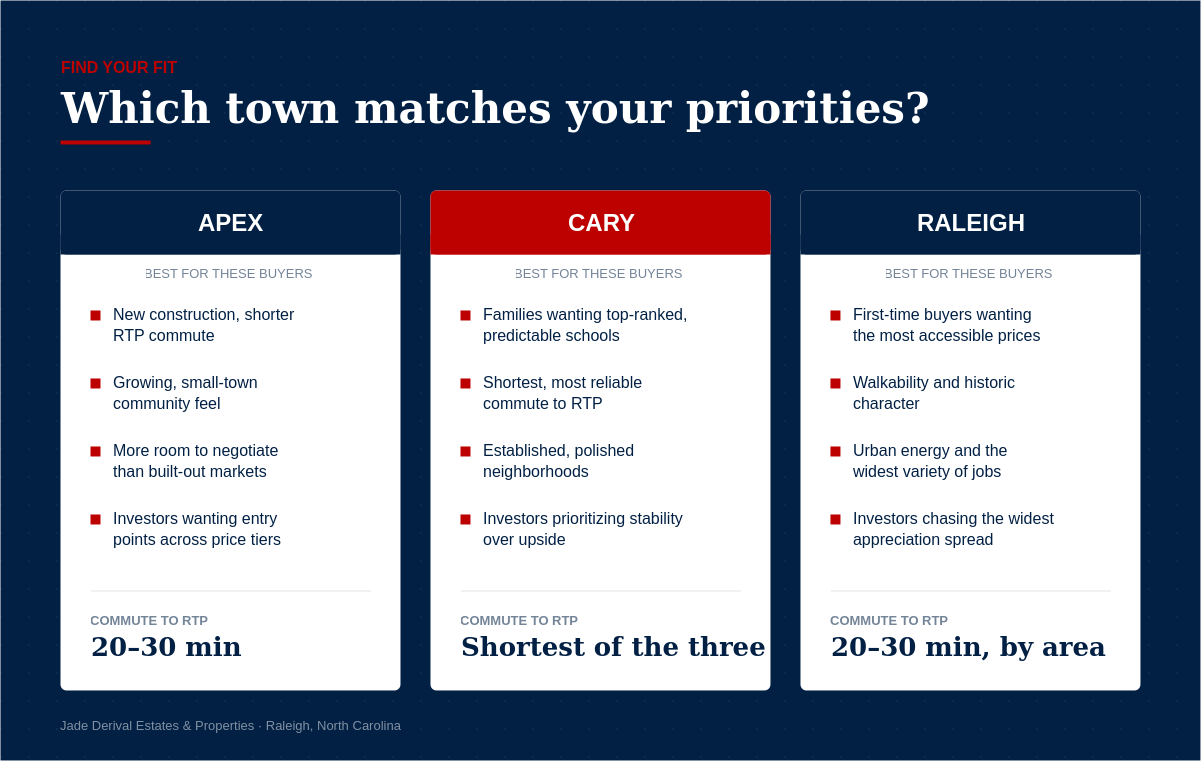
Putting all of the above together, here’s how these three towns tend to line up against the priorities we hear most often from buyers:
- First-time buyers prioritizing affordability: Raleigh’s broader price range offers the most accessible entry points, particularly in neighborhoods outside the immediate downtown core.
- Families prioritizing schools and predictability: Cary’s consistent demand and top-ranked schools make it a dependable choice, especially for buyers who want an established neighborhood over new construction.
- Buyers wanting new construction and a shorter RTP commute: Apex’s growth corridor offers newer inventory at a competitive pace, with more room to negotiate than Cary.
- Investors seeking appreciation potential: Raleigh’s in-town neighborhoods and Apex’s new construction pipeline both offer upside worth evaluating individually rather than assuming one town outperforms the other.
- Buyers who want walk-ability and historic character: Raleigh’s inside-the-belt line neighborhoods lead here, with a level of architectural variety Apex and Cary don’t offer.
- Buyers who want the shortest possible RTP commute: Cary’s central location gives it a practical edge over both Apex and most of Raleigh.
Frequently Asked Questions
When it comes to buying a home for the time people often ask which place is better: Apex, Cary or Raleigh?
Raleigh usually has homes that first-time buyers can afford. Apex has new homes that can also be a good option depending on the neighborhood you like.
Which town has the commute to RTP is another question people have?
Cary is in the middle so it usually has the commute to RTP but some neighborhoods in Raleigh and Apex can be just as close depending on the route you take and the time of day. “
People also want to know where home values are going up the right now.
The thing is, home values are going up differently in neighborhoods not just in different towns. Some neighborhoods in Raleigh have seen a jump in home values recently while Cary and Apex have more steady and predictable growth.
A lot of people are wondering if now is a time to buy a home in the Triangle?
There are homes for sale in Apex, Cary and Raleigh than there were a few years ago so buyers have more choices and can negotiate better prices especially when compared to 2021 and 2022. However, Cary is still a market especially, for homes that are priced well.
When it comes to buying a home for the time people often ask which place is better: Apex, Cary or Raleigh?
Raleigh usually has homes that first-time buyers can afford. Apex has new homes that can also be a good option depending on the neighborhood you like.
Which town has the commute to RTP is another question people have.
Cary is in the middle so it usually has the commute to RTP but some neighborhoods in Raleigh and Apex can be just as close depending on the route you take and the time of day.
People also want to know where home values are going up the right now?
The thing is, home values are going up differently in neighborhoods not just in different towns. Some neighborhoods in Raleigh have seen a jump in home values recently while Cary and Apex have more steady and predictable growth.
Conclusion
Apex, Cary and Raleigh are all places to live in the Triangle. The best one for you does not depend on how much houses cost on average. It depends on what you want: how long it takes to get to work what school district you are in how fast houses are. What you want to happen in the long term.
When you are looking to buy a house, you should look at what’s happening in each neighborhood not just the whole town. When you are selling a house, you should think about what’s happening right now in your neighborhood not what happened last year. When you are investing in a house you should think of each town as an opportunity, not just part of the whole Triangle area.
No matter what you decide numbers are part of the story. You will learn a lot more about Apex, Cary and Raleigh if you spend time in each town. Walk around the neighborhoods. Talk to someone who knows the area really well. They can tell you about the market and help you figure out what you want. This will tell you more than looking at average prices, for the whole city.
Ready to find out which of these communities fits you best? Reach out for a personalized comparison of neighborhoods, current listings, and pricing across Apex, Cary, and Raleigh, tailored to your budget and lifestyle.