
If you’ve been watching for-sale signs pop up around Raleigh, Cary, Apex, Holly Springs, Fuquay-Varina, Morrisville, Wake Forest, or Garner this summer, you’re not imagining things — the Wake County NC real estate market has more inventory sitting on it right now than it has in years. Combine that with a wave of infrastructure and commercial development stretching from downtown Apex to the future Complete 540 corridor, and this is shaping up to be one of the more interesting summers the Triangle has seen since before the pandemic.
Whether you’re a longtime homeowner wondering what your equity is doing, a buyer who got priced out in 2022–2023, or a family relocating for a Research Triangle Park job, here’s a grounded look at where the market actually stands and how the region’s growth is reshaping opportunity block by block.
Wake County Housing Market Snapshot: Inventory Is Up, Prices Are Leveling Off
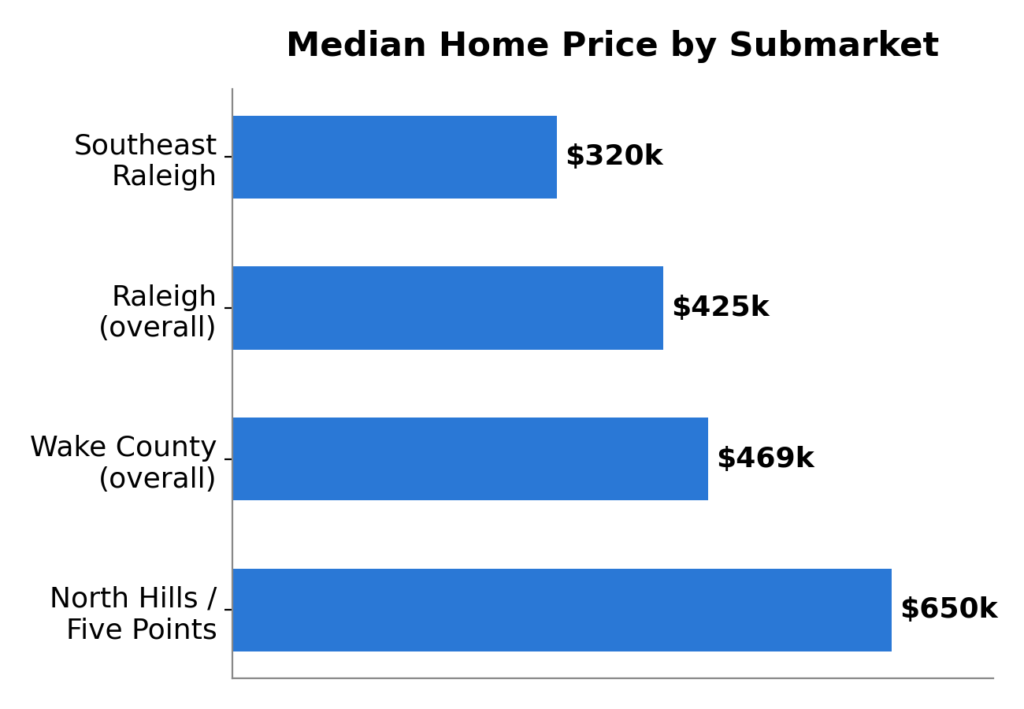
The headline shift in the Triangle this year is supply. Active listings in Wake County reached 3,528 in January 2026, roughly 21% more homes on the market than the same month the year before, while the county’s median home price came in at $450,000, down slightly year-over-year. By June, county-wide data put the median single-family price at $469,000, with homes typically taking longer to find a buyer than they did during the frenzied years of 2021–2022.
That “longer” is measurable: median days on market in Wake County has stretched into the low-to-mid 40s, up meaningfully from the high-20s/low-30s pace of a couple years ago. Raleigh itself has followed the same script recent data puts the city’s median sale price in the mid-$420,000s, down modestly year-over-year, with homes averaging roughly a month on market before going under contract.
None of this points to a downturn. It points to a market resetting toward something closer to historical normal after several years of extremes. As one Cary-based appraiser who tracks the region put it, this is the first time since 2019 the Triangle has felt genuinely balanced.
What’s Driving the Shift
A few forces are converging at once:
- Mortgage rates easing toward 6%, which is drawing some sidelined buyers back in without fully offsetting years of pent-up inventory growth.
- New construction volume, especially in Wake Forest, knight dale, Wendell, and the western Wake corridor, giving buyers builder incentives, rate buy-downs, and closing-cost assistance that resale sellers now have to compete with.
- A widening city-to-suburb price spread. Realtor.com data shows Raleigh listing prices ranging from the $300,000s in Southeast Raleigh to well over $600,000 in North Hills and Five Points, meaning “the Raleigh market” is really dozens of micro-markets moving at different speeds.
Not Every Neighborhood Is Slowing Down the Same Way
Here’s the nuance sellers need to hear: this is not a uniformly buyer-friendly market. Local agents describe two very different realities happening at once. Some homes are sitting for months and closing well under list price, while well-priced, move-in-ready homes in the right locations are still drawing multiple offers within days.
The strongest, most consistent demand right now is concentrated in what agents call the region’s “lifestyle locations” — inside the Raleigh belt line, North Hills, Midtown, Cary, Apex, Holly Springs, and parts of Wake Forest. These areas share strong schools, walk ability or newer housing stock, and steady pull from relocation buyers moving in for Triangle jobs. Meanwhile, pockets of Wake Forest, knight dale, and Wendell are where buyers are finding the most room to negotiate, largely because new-construction supply has taken some pressure off resale pricing.
For sellers, the takeaway is blunt: buyers are more discerning than they’ve been in years. A home that’s accurately priced, freshly staged, and well-photographed from day one still moves quickly. A home that misses on price or presentation doesn’t just sit a little longer it can sit for months while newer, better-marketed listings pass it by.
Apex and the Southwest Wake Growth Corridor
Nowhere in the Triangle illustrates the region’s growth story better than Apex right now. The town’s veridian development broke ground on its next phase this spring two industrial/research buildings expected to bring up to 150 jobs when finished in 2027, part of a larger master-planned community slated to eventually include roughly 8,000 homes, a children’s hospital, a Wake Tech campus, and more than a million square feet of retail. Apex’s mayor has been candid that the town is currently about 82% residential and only 18% commercial, and that shifting that balance, through projects like veridian and the nearly 250-unit, mixed-use sweet-water Town Center, is a deliberate strategy to diversify the tax base and bring more day-to-day amenities within reach of residents.
Apex is also mid-stride on a downtown streets-cape project widening sidewalks for outdoor dining and adding new lighting and furniture, and the town’s Peak Plan 2055 task force is actively updating its comprehensive land-use, transportation, and NC 55 corridor plans this summer, a process that will shape zoning and density decisions across Apex for the next three decades.
For buyers and investors, this matters because infrastructure and land-use planning almost always show up in home values before they show up in headlines. Areas slated for new commercial density, transit investment, or corridor widening tend to see appreciation lag, then accelerate, once construction visibly wraps.
Complete 540 and the Ripple Effect Across the Southeast Triangle
The single biggest long-term infrastructure story for Wake County real estate is Complete 540, NCDOT’s project to finish the outer loop by extending the Triangle Expressway from the NC 55 Bypass in Apex to US 64/US 264 near knight dale. Once finished, this new limited-access toll road will directly connect Apex, Cary, Garner, Fuquay-Varina, Holly Springs, and Raleigh, materially cutting commute times across the southeastern part of the county.
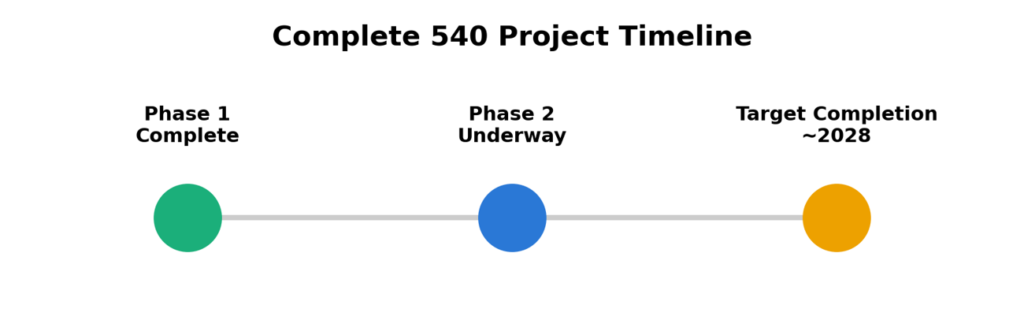
Phase 1 construction is already complete and Phase 2 is underway, with a target completion around 2028. Historically, commercial and residential land near new outer-loop interchanges in the Triangle has seen some of the fastest appreciation in the region once a project moves from “planned” to “under construction”, which is exactly where several segments of Complete 540 stand today. Fuquay-Varina and Holly Springs, both directly on this new connector, are worth watching closely over the next 24 months.
What This Means If You’re Buying
If you’ve been waiting for a true break in Triangle housing costs, this is closer to it than the market has been in years, but “more balanced” doesn’t mean “cheap.” You’ll likely have more homes to choose from, more room to negotiate on properties that have been sitting, and access to builder incentives in growth corridors like Wake Forest, Fuquay-Varina, and southwest Wake County. Just don’t expect that leverage in the tightest, most in-demand pockets — inside-the-belt line Raleigh, North Hills, and the established parts of Cary and Apex are still moving fast when priced right.
What This Means If You’re Selling
Pricing discipline matters more in mid-2026 than it has in years. With inventory up double digits year-over-year in much of Wake County, buyers have options, and they’re using them. The homes still generating multiple offers are the ones that are priced from comparable sales (not last year’s headlines), staged well, and photographed professionally from the first day on market. If your home has been sitting, it’s worth an honest conversation about whether price or presentation is the sticking point before dropping the price reflexively.
What This Means If You’re Relocating or Investing
The Triangle’s underlying growth story hasn’t changed, it’s just moderating from an unsustainable sprint to a steadier jog. Job growth tied to Research Triangle Park, tech, and healthcare continues to draw new residents, and projects like veridian and Complete 540 are direct evidence that both public infrastructure and private capital are still betting heavily on southwest and southeast Wake County. For investors and relocation buyers with a multi-year horizon, the current combination of higher inventory, more negotiating room, and continued long-term growth catalysts is a rare window that didn’t exist in 2021 or 2022.
Bottom Line
The Wake County NC real estate market in mid-2026 is defined by more choice, more negotiating room in some pockets, and continued fierce competition in others — with major infrastructure projects like Complete 540 and large-scale developments like veridian quietly reshaping where the next wave of demand will land. Reading the market well right now means looking past the county-wide averages and understanding what’s actually happening street by street.
Ready to Talk Strategy for Your Situation?
Whether you’re trying to time a sale in Cary, find value in Fuquay-Varina before Complete 540 finishes, or figure out what a relocation budget actually buys in today’s Raleigh Triangle market, a locally grounded second opinion helps. Reach out to Jade Derival for a personalized read on your neighborhood, your timeline, and your next move.
FAQ’S
-
Is the Wake County housing market crashing in 2026?
No. Inventory has increased and price growth has leveled off, but this is best described as the market resetting toward a historical normal after several years of extremes, not a downturn.
-
Why has inventory increased so much in Wake County?
Active listings reached 3,528 in January 2026, roughly 21% more than the same month a year earlier. Easing mortgage rates are drawing some buyers back, but new construction and years of pent-up supply are outpacing that demand for now.
-
Are home prices falling in Wake County?
Prices have leveled off rather than fallen sharply. The median home price came in at $450,000 in January 2026, down slightly year-over-year, before rising to $469,000 by June as the year progressed.
-
Why are homes taking longer to sell right now?
Median days on market has stretched into the low-to-mid 40s, up from the high-20s/low-30s pace of a couple years ago, since buyers now have more inventory to compare and less pressure to rush a decision.
-
Is it currently a buyer’s market or a seller’s market in Wake County?
Neither, uniformly. It behaves like a seller’s market for well-priced, move-in-ready homes in strong locations, and more like a buyer’s market for homes that are overpriced, dated, or in less central areas.
-
Which areas of Wake County still have the strongest demand?
Inside the Raleigh belt line, North Hills, Midtown, Cary, Apex, Holly Springs, and parts of Wake Forest continue to see the most consistent demand, thanks to schools, walk ability, and steady relocation buyers.
-
Where do buyers currently have the most negotiating room?
Pockets of Wake Forest, knight dale, and Wendell offer buyers more leverage right now, largely because new-construction supply has taken pressure off resale pricing in those areas.
-
What is Apex’s veridian development, and why does it matter?
Veridian is a large master-planned development in Apex expected to eventually include roughly 8,000 homes, a children’s hospital, a Wake Tech campus, and over a million square feet of retail. It’s part of a deliberate push to shift Apex’s tax base, currently about 82% residential and 18% commercial, toward more commercial density.
-
What is Complete 540, and how could it affect home values?
Complete 540 is NC Dot’s project to finish the outer loop, connecting Apex, Cary, Garner, Fuquay-Varina, Holly Springs, and Raleigh via a new limited-access toll road, targeted for completion around 2028. Areas near new interchanges have historically seen accelerated appreciation once projects move from planned to under construction, making Fuquay-Varina and Holly Springs worth watching.
About The Author:
Jade Derival is a licensed REALTOR® with Kelly Right Real Estate of North Carolina, proudly serving home buyers, sellers, and investors throughout Holly Springs, Raleigh, Cary, Apex, and Wake County. With a client-first approach and in-depth knowledge of the local real estate market, Jade is committed to helping her clients make informed, confident decisions at every stage of their real estate journey.
Whether you’re purchasing your first home, upgrading to your dream home, selling your current property, or exploring investment opportunities, Jade provides personalized guidance, honest communication, and strategic market insights tailored to your unique goals. Her mission is to make every transaction as seamless and rewarding as possible while building lasting relationships based on trust and exceptional service.
📱 412-352-1899
📧 Jderival@kellyright.com
Kelly Right Real Estate of North Carolina